A practical look at location labels, opening-hour searches and the limits of claims about Melbourne pokie venues.
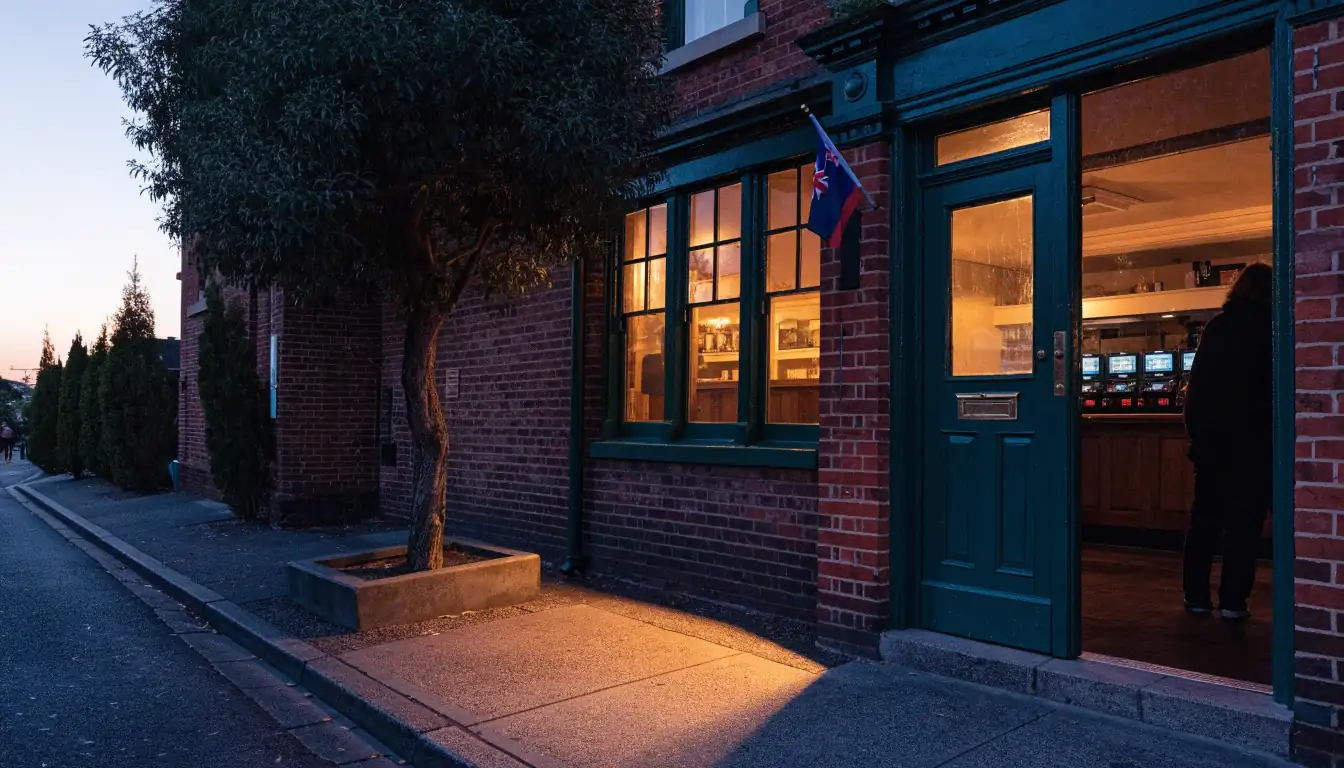
A search for pokies near Melbourne Airport is best treated as a question about location, not as confirmation that a venue is inside the airport or within a particular distance of it. The same distinction applies to Melbourne Central, the CBD and Port Melbourne. A place name narrows the area being considered; it does not establish which venues are there, what they offer or how easy they are to reach.
I separate the destination from the landmark used to describe it. “Near the airport” might mean somewhere in the surrounding area, while “at the airport” suggests a facility within the airport itself. Those are different claims. A result appearing beside an airport on a map does not settle which one is intended. The address and the venue’s own information matter more than the wording attached to a map pin.
That distinction is useful when arriving in Melbourne with limited time or unfamiliar transport options. A location that looks close on a screen may not be close in practice, and a broad label such as “Melbourne” can cover a large area. Before making a trip, it is sensible to confirm the venue’s street address and check how the route works from the actual starting point: the terminal, station, hotel or other arrival location. The route, not the search phrase, is the practical unit.
Choosing pokies online in Melbourne calls for checking the information available about each operator before deciding where to play. This list provides a concise reference to the stated licensing, deposit and payout details.
WinSpirit Casino
WinSpirit Casino lists a Curaçao eGaming licence, OGL/2024/923/0383, issued through Antillephone N.V. Its stated minimum deposit is A$30.
DragonSlots Casino
DragonSlots Casino is associated with the Curaçao Gaming Authority and operated by Jumpman Gaming Ltd.
Vegaz Casino
Vegaz Casino lists Curaçao licence OGL/2024/1335/0780. Its stated minimum deposit is EUR 20.
Neospin
Neospin lists Curaçao Gaming Control Board licence OGL/2023/176/0095, held by Hollycorn N.V.
Uptown Pokies
Uptown Pokies has been operating since 2017 and lists Curaçao as its jurisdiction. Its stated minimum deposit is A$20.
7Bit Casino
7Bit Casino is operated by Dama N.V. and lists Curaçao as its licensing jurisdiction.
SkyCrown
SkyCrown lists a Tobique Gaming Commission licence. Its stated payout times are around 10–15 minutes for crypto and 1–5 days for fiat, with a minimum deposit of A$30.
Kingmaker
Kingmaker lists payout times of around 90 minutes for crypto and 1–5 days for fiat. Its stated minimum deposit is A$30.
MrPacho
MrPacho lists crypto payout times of 30–120 minutes and fiat payout times of 24–72 hours. Its stated minimum deposit is A$30.
GoldenCrown
GoldenCrown lists Curaçao Gaming Control Board licence OGL/2023/176/0095, held by Hollycorn N.V.
The same method applies to Melbourne Central. A result associated with that landmark could refer to a venue in the surrounding district rather than inside the centre. The address should make clear whether the destination is in the building, on a nearby street or elsewhere in the CBD. If the listing gives only a neighbourhood label, it has not answered the location question.
Port Melbourne needs the same care. The suburb name can be useful for narrowing an area, but it does not identify a particular venue or establish that a result is close to a chosen destination within the suburb. I would read the address as the deciding detail, then compare it with the point from which the trip would begin. A suburb-level match is a starting point, not a final check.
This is where map results can create false confidence. A pin may be approximate, a business listing may use a broad area name, or the displayed category may not tell the whole story. I do not treat proximity on a map as proof of a venue’s facilities. The listing and the venue’s own current information should agree on the name and address before the location is relied on. If they do not, the uncertainty remains.
There is also a difference between a place being listed and the relevant activity being available there. A directory entry, a venue name or a result attached to a transport hub does not by itself confirm that pokies are present. Nor does a general location description say anything about the machines, access arrangements or conditions at that venue. Those details need to come from venue-level information, not from the map label.
 Best pokies in Geelong: checking venue statusLearn why an online “open” listing may not confirm pokies are operating, and how to distinguish venue status from search snippets and…
 Pokies in Tasmania: Hours and Verified DetailsLearn why venue opening hours do not confirm gaming-area availability, what venue-level information can establish, and where online pokies meet Australian legal
For airport-area planning, I would check the exact destination against the terminal or other arrival point rather than assuming that “near” means a short walk. If transport is part of the plan, the route should be checked from the specific terminal or station, not from a generic airport marker. The same principle works for anyone arriving through another transport point: use the actual arrival location as the origin, then confirm the destination address independently.
“Near me” is even less precise. It depends on the location being used by the device or service and may change when the starting point changes. It is useful for finding an area to investigate, but it is not a reliable description of distance or access on its own. A result near the current position may be irrelevant once the trip begins from a different place.
From behind the counter, I learned not to confuse a tidy listing with a checked detail. Location language is often compressed for convenience; the address carries the weight. When a result says Melbourne, the airport, Melbourne Central or Port Melbourne, the sensible next step is not to infer more than it says. Confirm the street address, identify the intended arrival point, and make sure both refer to the same destination.
No ranking is needed to solve this problem. It is a matter of matching a named area to a precise address and a real route. If the information stops at a landmark or suburb, the location has not yet been established. The label is not the destination.
“Open now” answers a narrow question: whether a venue is listed as open at the time of checking. It does not, by itself, establish that every part of the venue is accessible, or that a particular gaming area is operating. Those are separate details, and a general opening-hours listing may not explain them.
I learned to separate the door from the floor. A venue can be open for food, drinks or other activities while access to a gaming area is governed by different hours or conditions. The reverse can also be true: a listing may show a venue as open without saying whether the area someone has in mind is available. An opening label is not a live status report for each room or service.
That distinction matters when checking whether pokies are available early, late or at a particular point in the day. A result that says a Melbourne venue is open does not confirm that its gaming facilities are operating at that moment. Nor does an hours panel necessarily explain exceptions, temporary changes or entry conditions. The useful follow-up is venue-specific information that clearly refers to the gaming area, rather than a general listing for the whole premises.
Hours can be displayed in search results, on maps, on a venue’s own pages or through directory listings. Each may describe the business overall, and details can differ if one listing has not been updated. A neat “open” label looks definitive; in practice, it may only summarise the hours supplied for the venue.
I treat that label as a starting point, not confirmation. The stronger check is a current statement from the venue that covers both the relevant area and the time in question. If the available information is unclear, a direct enquiry can resolve the difference between general access and gaming-area access. It is also sensible to check again before setting out, since a published schedule can be changed.
This is especially relevant to searches framed around opening at a specific early hour. Search wording cannot supply an answer where the venue has not published one. A general venue schedule may look like a match, but it should not be read as proof of when pokies begin operating. No guess based on another venue’s hours fills that gap.
The same caution applies to late access. “Open” may describe some part of a business, not continuous availability of every facility. I would not infer gaming-area hours from a restaurant listing, a bar listing or a broad venue profile. Different services can have different schedules. Check the specific service.
The word “available” can blur two unrelated things: being able to enter a physical venue and being able to reach a game online. A venue-hours result concerns a place and its operating arrangements. It says nothing about whether a website or app is a lawful alternative.
In Australia, the Interactive Gambling Act 2001 prohibits operators from providing real-money online casino games, including pokies, to people in the country. There is no Australian-licensed online casino. A site loading on a phone is not evidence that its real-money casino offering is authorised here, and online access should not be treated as a substitute for checking physical venue hours.
Legal Warning
The Interactive Gambling Act 2001 prohibits operators from providing real-money online casino games, including pokies, to people in Australia.
That is a different issue from whether a venue is open. Mixing the two can make a vague result seem more useful than it is. Physical access has to be confirmed with the venue; online reachability does not establish a lawful local casino service.
I use three separate checks: whether the venue is open, whether the relevant gaming area is operating, and whether any conditions affect access. A single status label may cover only the first. The distinction is plain, but easy to miss when a listing compresses several details into one word.
The same care applies to the meaning of “payout” in an opening-hours context. A venue being open does not reveal a pokie’s return settings or predict what an individual session will produce. Those are machine-level questions, not questions answered by a venue schedule. Each spin is an independent random event.
Responsible-gambling tools belong to yet another layer. Deposit and loss controls, session-time settings and self-exclusion can help structure or stop play; they do not confirm venue hours, and they do not turn an opening label into a promise about availability. Separate questions need separate answers. No shortcut.
A pokie’s name and appearance identify the game, not necessarily the return setting used on a particular machine. I learned to separate those details because “high paying” sounds like a property of the game itself, when a return-percentage claim may depend on how the game has been configured.
A specialist review reports that some providers allow casinos to choose between multiple return-to-player (RTP) settings for the same pokie. On that basis, the same named game could have different stated return percentages in different casinos. The game’s title, graphics or familiar features do not establish which setting is in use. Nor does finding the same game elsewhere settle the question.
RTP describes a theoretical share of stakes returned across a very large number of plays, rather than a forecast for a session or a promise about an individual result. It is useful as a measure only when the figure is tied to the actual setting being discussed. A percentage shown without clear context can leave the key detail unanswered: does it refer to this version of the game, and to the setting operating on this machine?
That distinction matters when a Melbourne casino pokie is described as one of the “best paying”. The phrase is a ranking claim, not a machine specification. Without a confirmed return figure for the exact setting, the label does not show that one game will pay more to a particular player, or that it will produce a win during a visit. I would treat the wording as a prompt to check the underlying detail, not as evidence of an advantage.
The randomness of each spin is a separate point. Every spin is an independent event determined by a Random Number Generator (RNG). Previous results do not make a particular outcome due, and a run of wins does not establish that another is more likely. Likewise, a long stretch without a win does not mean the machine is building towards one. The independent event is the basic mechanic; the return setting is a different piece of information.
Every spin is an independent event determined by a Random Number Generator (RNG); previous results do not make a particular outcome due.
In practice, the useful questions are narrow: is an RTP figure available for this specific game setting, and is it clear which setting the figure describes? If the answer is not apparent, the game’s branding cannot fill the gap. A familiar title may appear in more than one place, but its identity alone cannot confirm that every machine is configured alike.
This is why “best” needs careful handling. It can refer to a player’s preferred theme or features, or it can imply a measurable return advantage. Those are not interchangeable meanings. A claim about return needs a relevant setting and a reliable basis; a recommendation based on a game’s look or reputation says nothing definite about its configured RTP.
I have seen how a neat promotional label can compress several distinct ideas into one phrase. The game is recognisable. The setting may not be. And an individual spin remains random. Keep those distinctions separate, and claims about pokies in Melbourne casinos become easier to assess without mistaking presentation for machine-level information.
A venue’s reputation, décor or size does not tell the whole story about how it handles gambling harm. When I assessed venues from the operational side, the useful distinction was between what a place promoted and what staff were expected to do when play stopped looking recreational. Responsible practice is not a label on a directory listing. It depends on procedures, trained people and records that can be checked.
A report by regionriverina.com.au says that, from 1 July, venues operating more than 20 gaming machines are required to have a dedicated responsible gambling officer (RGO) on duty while those machines are running. That makes the RGO a defined operational role, rather than a general promise that someone on shift can help. The report also describes a one-month transition period for venues to remove signage and put the officer arrangements in place. These are reported requirements, not a basis for assuming that every Melbourne venue has the same staffing or implementation status.
The same report says venues will need to maintain a gambling incident register. It is intended to capture events such as a patron showing behaviour that suggests they may be at risk of, or experiencing, gambling harm. The value of a register is practical: it creates a record of what staff noticed and how the venue responded, rather than leaving an incident to memory or informal conversation. A written procedure matters only if staff know when to use it.
There is a difference between a venue having a policy and that policy shaping what happens on the floor. From behind the counter, I learned that an intervention can be awkward: staff must respond to an individual without turning the interaction into a spectacle. A clear escalation path helps. So does knowing who is responsible when a concern arises, and how the incident is documented afterwards. The paperwork is not the care itself. It is evidence that the venue has a process.
The physical environment also matters. Signage directing patrons to gaming lounges should not be placed within sight of ATMs or EFTPOS terminals. Signs pointing to ATMs should not be visible from gaming machines. That is a concrete placement issue, not merely a question of whether the wording sounds responsible. A venue can review its signs by considering what a patron can see from each relevant area.
For someone comparing Melbourne pokies venues, “best” is therefore not a reliable category on its own. A rating or promotional phrase cannot establish how an RGO is deployed, how staff recognise concerning behaviour, or whether records and escalation procedures are handled properly. Those are venue-level questions. They do not depend on a machine’s advertised identity, and they cannot be answered by a claim about atmosphere.
I would treat visible, consistent processes as more meaningful than polished language: staff should be able to explain who handles a concern, and venue information should not blur the line between support and promotion. A venue’s responsibilities are operational, not decorative. No slogan replaces the process.
Crown Melbourne is a venue-specific search, but the name alone does not answer practical questions about pokies there. It does not establish which machines are available, how a particular room is arranged, whether a machine is operating, or what conditions apply on a given visit. Those details need confirmation from Crown’s current venue information; they cannot be inferred from general statements about Australian pokies.
I have seen how easily a broad claim gets treated as a precise one. A description of a game, a venue, or the wider market can sound definitive while leaving the operational detail unstated. “Best pokies room” is especially slippery: “best” might refer to layout, atmosphere, game choice or convenience, but none of those qualities follows from a venue name. Without reliable, current information about the specific feature being compared, a ranking would be assertion rather than guidance.
There is also a distinction between a physical venue and an online casino. The Interactive Gambling Act 2001 prohibits operators from providing real-money online casino games, including pokies, to people in Australia; no Australian online casino licence has been issued. That legal position concerns online services. It does not, by itself, confirm a particular machine, room, operating arrangement or other venue-level detail at Crown Melbourne.
The game’s advertised identity is another separate matter. A title or familiar presentation does not establish the return setting of an individual machine. Some providers allow different return settings for the same game, and each spin remains an independent random event determined by a Random Number Generator. Those are general mechanics, not confirmation of Crown Melbourne’s machine selection or settings. The distinction matters. A game name is not a settings sheet.
For Crown-specific information, the useful evidence is the venue’s own current material or a direct confirmation from the venue, with the detail matched to the question: machine selection, room access, facilities or operating arrangements. Information about one of these should not be stretched to answer another. Nor does a general account of Melbourne venues establish Crown’s machine count or conditions.
I would treat any claim about Crown Melbourne pokies as incomplete unless it identifies what it actually verifies and when that information applies. A broad promotional label can describe an impression; it cannot substitute for operational detail. For a visit, the practical distinction is simple: general knowledge explains how pokies work, while only current venue-specific information can establish what Crown Melbourne offers or has available.
“Cashless” can describe different things, and the distinction matters. PayID is a way to transfer money between bank accounts; it is not a feature that proves a pokie is fair, that a venue accepts cashless play, or that an online gambling service is lawful. A payment rail answers how money moves. It does not answer whether the underlying activity is permitted.
Attention: A successful PayID transfer is a payment mechanic and not a regulatory endorsement or evidence that a service is lawfully offering real-money pokies in Australia.
PayID works as an alias layer on the New Payments Platform (NPP). Instead of entering bank account details, a sender can use an email address, mobile number or Australian Business Number linked to the recipient’s account. The NPP is supported by major banks and uses end-to-end encryption, but those mechanics describe the transfer system, not the gambling operator receiving funds. A successful transfer is not a regulatory endorsement.
That separation is easy to lose in promotional language. “PayID accepted” may sound like a trust mark; it is only a payment claim. It says nothing by itself about game settings, payout terms, consumer protections or whether the service may legally offer real-money pokies in Australia. I have seen payment logos do a lot of persuasive work while answering none of those questions.
The legal boundary is clear. Under the Interactive Gambling Act 2001, companies cannot offer real-money online casino games to people in Australia without a domestic licence, and no Australian online casino licences have been issued. There is no Australian-licensed online casino. This is not a distinction between a Melbourne website and a distant website: the relevant issue is the real-money service offered to people physically in Australia.
Offshore sites may still be accessible, but access does not create local protection. ACMA blocks illegal offshore gambling sites, and internet providers must comply with its blocklist. If an offshore casino refuses to pay winnings, an Australian player has no legal recourse in Australia. That is a serious gap, not fine print.
Payment and account checks do not repair it. Before a first withdrawal, identity documents and proof of address should be verified; a site’s request for those documents is not evidence of Australian licensing. BetStop is also limited: it applies to Australian-licensed operators and does not bind offshore sites. Since there are no Australian-licensed online casinos, it should not be mistaken for a safeguard that controls offshore casino accounts.
In physical venues, a cashless payment arrangement and a pokie’s operation are separate questions again. PayID transfers funds through a bank-linked alias; it does not identify which Melbourne venues offer cashless play or establish any machine’s settings. “Cashless pokies” can therefore refer to a payment arrangement, not a guarantee about what is being played or under what conditions. Different questions. Different protections.
A claim of round-the-clock pokies access is more specific than a venue being open late. It says that access continues through the night and into the next day, without a daily closure. A venue’s general opening hours do not establish that claim on their own.
I learned to separate the headline from the operating detail. “Open 24 hours” may describe a broader venue, while the gaming area could have different operating arrangements. The wording can also become stale when a venue changes its schedule. A result that repeats the phrase is not the same as a current confirmation from the venue.
That distinction matters in Melbourne, where a broad description cannot safely be treated as a promise about every location. The name of a venue, its address and its hours need to match; a page about one site does not establish the hours of another. Even an apparently clear listing can leave out whether the stated hours apply to the whole venue or specifically to its pokies.
Use the venue’s own current information and confirm specifically that the gaming area—not just the general premises—is operating without daily closure. If the wording is unclear, contact the venue directly before travelling.
The practical check is direct and local. Use the venue’s own current information, then confirm that it refers to the relevant location and to pokies access rather than general entry. If the wording is unclear, contact the venue before travelling. A listing that says “open now” answers a different question: it reflects a status at a particular moment, not necessarily continuous operation.
“Always open” is a strong claim. The phrase sounds simple, but it compresses several details: which part of the venue is open, whether the gaming area follows the same schedule, and whether the information is current. Those details belong to the venue, not to a city-wide label or a search result.
I would not treat a late closing time as evidence of uninterrupted access, either. Nor does a venue’s general reputation settle the matter. Hours can be location-specific and may change, so a copied description on another page is weaker than a current statement from the venue itself.
For anyone comparing Melbourne pokies hours, the useful distinction is between a venue that operates late and one that confirms continuous access to its gaming area. If the exact wording cannot be confirmed at venue level, the “24-hour” label remains an unverified description. Better to know before setting out.
Regional searches are best treated as a way to narrow a map, not as evidence that a particular suburb has a particular venue. “East Melbourne” and “South East Melbourne” can describe broad areas rather than a precise destination. The western suburbs are similarly wide-ranging. A result that uses one of these labels may be speaking loosely, so the suburb or street address matters more than the regional tag.
I used to see the same distinction at the counter: people arrived with a broad area in mind, while the useful detail was the actual venue location. A map can help compare routes across Melbourne, but a regional label alone cannot confirm that a venue exists there, offers pokies, or is open. That needs checking against current venue information. No shortcut.
St Kilda is a recognisable suburb, but its name in a listing still does not establish what is available inside a venue. The same applies to places described as being in Melbourne’s east or west. Venue details and machine details are separate questions; a suburb name answers neither by itself.
A phrase that combines Newcastle with Melbourne also needs untangling. Newcastle is a separate city, not a Melbourne suburb, so the location being sought should be resolved before comparing destinations. Otherwise, results from different places can be mixed together and make a regional comparison misleading.
“Max bet” is another search phrase that belongs to the machine, not the map. It refers to a stake setting, whereas east, south-east, west and St Kilda are location clues. A venue’s suburb cannot establish the maximum stake on a particular pokie, and a machine claim does not identify where it can be found. Those are different checks.
From an operational point of view, broad labels are useful for orientation but poor as proof. The name of a suburb, the exact address and the detail being checked should line up before a venue is treated as a match. This avoids turning a loose regional description into a promise about the pokies on site.
The practical approach is to narrow the area first, then verify each destination using its own current information. For a trip across Melbourne, route convenience and venue identity are separate considerations. For a machine-specific question, the venue’s location is only the starting point; it does not settle the machine condition. No regional ranking follows from these labels.
A club in Melbourne’s CBD and a pokie inside it are two separate things to verify. A venue listing can establish an address or describe facilities, but it does not prove that a particular club has pokies, that a gaming area is operating, or that a machine is available. I learned to keep those questions separate: the venue controls access and house procedures; the machine runs its own game configuration.
The word “best” does little work here. It might mean a preferred venue, a particular title, or an assumption about payouts. None of those follows from a club’s name or from the machine’s display. Each spin is an independent event generated by a Random Number Generator; a previous result does not make a later one due. A game’s familiar title, theme or feature set is not a promise about what an individual spin will return.
Configuration also matters. A specialist review reports that some providers give venues a choice of return-percentage settings for the same game. That means the title alone cannot establish its setting at a particular location. The practical distinction is simple: venue-level information describes the premises and its policies; machine-level information concerns the specific game and configuration. One does not substitute for the other.
For a CBD club, the useful checks are therefore concrete: whether the venue itself confirms gaming facilities, what access conditions apply, and whether it explains its responsible-gambling procedures. For a particular machine, the relevant information is the displayed game rules and any available setting disclosure. If the setting cannot be established, a confident claim based only on the game’s branding is not evidence.
Self-exclusion is a separate venue-process question, not a feature that can be inferred from a club listing or from a machine. Responsible-gambling tools include self-exclusion, but the practical steps and scope need to be confirmed with the relevant venue. I would treat any vague assurance as incomplete until the process is clear.
A report published by regionriverina.com.au described a one-month grace period for venues to remove signage and introduce responsible gambling officers. That is a reported transition measure, not proof of the current arrangements at any particular CBD club. Check the venue’s present procedures directly. Details matter.
North Melbourne and South Melbourne are separate local searches, not reliable labels for a single cluster of venues. A result described as being “near” either area may sit outside the suburb itself. I learned to treat the suburb name as a starting point, then check the actual street address before making plans. Map labels can blur neighbourhood boundaries.
The practical check is whether a venue’s own current information confirms that it operates there and offers pokies. A directory entry, an old review or a photograph of a gaming area does not establish present-day availability. Businesses change, listings linger, and a venue’s general description may not cover every facility on site.
It also helps to distinguish a venue from the particular area being sought. A result may describe a club, hotel or other hospitality business without confirming that pokies are available to the public at that location. Where the description is unclear, direct confirmation from the venue is more useful than inferring from a category label. Simple distinction.
I would also check that the address belongs to the intended side of the city, rather than relying on a broad map pin or a “near North Melbourne” description. That matters when comparing options across North Melbourne and South Melbourne: proximity wording can refer to a neighbouring suburb, not the named area.
No suburb label establishes what is operating inside a venue. The dependable approach is to verify the address, the venue’s own description and the specific facility before travelling. That keeps a local search local, without turning an unconfirmed listing into a promise.
There is no Australian-licensed online casino, and Australian players have no legal recourse in Australia if an offshore casino refuses to pay winnings. That makes playing on offshore sites a significant risk.
Free spins let you play selected spins, and the winnings may be subject to a cash-out cap. Bonus offers can come with wagering requirements that you must meet before withdrawing winnings.
Companies cannot legally offer real-money online pokies to Australian residents under a domestic licence, and no such licences have been issued. The law targets operators, not players, and Australians can legally play on offshore sites that accept them.