The article distinguishes brand identity, online availability, free play and real-money play, while explaining the limits of claims about casino listings.

The phrase “Aristocrat pokies” combines a brand attribution with a type of game. Online, that wording can describe what someone is trying to identify, but it does not by itself establish that a particular game is made by Aristocrat, that an online version exists, or that a named casino carries it. Those are separate claims, and each needs support of its own.
That distinction matters because a familiar name can make a description sound more definite than it is. A page may mention Aristocrat, pokies and online play in the same sentence while providing no identifiable title or evidence connecting the brand to a digital game. The wording may still be understandable as a topic label. It should not be mistaken for proof of a product.
The term “pokies” refers to the Australian way of speaking about slot machines. Adding “online” changes the setting being discussed; adding a maker’s name makes a claim about identity. It does not follow that every online pokie described with a brand name is an authorised digital release from that brand. Nor does a phrase such as “Aristocrat slot games” establish a catalogue, a version, or a route to play.
Choosing an Aristocrat pokies site in Australia means considering what is actually known about each operator, rather than relying on broad promises. This overview highlights the available licensing, deposit, and payout details to help you assess the options.
WinSpirit Casino
WinSpirit Casino lists a Curacao eGaming licence, OGL/2024/923/0383, issued through Antillephone N.V. Its minimum deposit is A$30.
DragonSlots Casino
DragonSlots Casino lists the Curacao Gaming Authority as its regulator and Jumpman Gaming Ltd as its operator.
Vegaz Casino
Vegaz Casino lists Curacao licence OGL/2024/1335/0780. Its minimum deposit is EUR 20.
Neospin
Neospin lists Curacao Gaming Control Board licence OGL/2023/176/0095, held by Hollycorn N.V.
Uptown Pokies
Uptown Pokies is described as operating since 2017 under a Curacao licence. Its minimum deposit is A$20.
7Bit Casino
7Bit Casino is described as operating under a Curacao licence, with Dama N.V. as its operator.
SkyCrown
SkyCrown lists a Tobique Gaming Commission licence and a minimum deposit of A$30. Payouts are listed at around 10–15 minutes for crypto and 1–5 days for fiat.
Kingmaker
Kingmaker lists a minimum deposit of A$30. Its stated payout times are around 90 minutes for crypto and 1–5 days for fiat.
MrPacho
MrPacho lists a minimum deposit of A$30. Its stated payout times are 30–120 minutes for crypto and 24–72 hours for fiat.
GoldenCrown
GoldenCrown lists Curacao Gaming Control Board licence OGL/2023/176/0095, held by Hollycorn N.V.
I separate those ideas rather than letting the label do the work. A game’s title would identify a particular product. A provider attribution would say who made or supplied it. An online availability claim would say where it can be accessed. Those statements may be related, but they are not interchangeable. Without support for the link between them, repeating the brand beside a generic description only creates an impression of confirmation.
This is especially relevant when a page uses broad headings such as “Aristocrat slots online” or “online Aristocrat pokies.” A heading can reflect the subject the page intends to discuss; it cannot substantiate the contents underneath it. The same applies to claims about the “best” games. A ranking needs identifiable entries and a basis for comparing them. A familiar name alone provides neither.
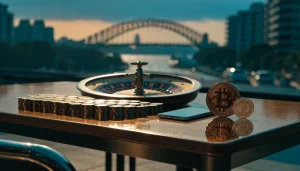
It concerns digital slot machines that take Bitcoin as a payment method. That tells us what the payment feature is; it does not identify the maker of any machine. Bitcoin acceptance is not a brand marker. It cannot establish that an Aristocrat title is involved, just as the word “online” cannot establish that an offline game has a corresponding online release.
In practice, this is where promotional language can blur categories. “Aristocrat-style” might refer to resemblance, while “Aristocrat” presented without qualification suggests an actual connection. “Compatible,” “inspired” or “available online” can also carry different meanings depending on what is being described. The words should not be treated as evidence by themselves. A precise statement names what is known and stops there.
I would also keep a casino label separate from a game label. A phrase like “Aristocrat casino” could be read as a casino associated with the brand, a casino that claims to offer its games, or simply a page grouping content under that phrase. The wording alone does not resolve which meaning is intended. It does not verify a partnership, a game library, or the presence of any specific title.
That is not a minor wording issue. Readers may reasonably understand a brand name as a promise of provenance. Careful writing avoids turning a search phrase into a product claim.
A useful boundary is simple: broad category terms describe the subject; a specific title and a substantiated attribution are needed to describe a particular branded game. General information about Bitcoin pokies belongs to the first category. It cannot be stretched into a claim about Aristocrat-branded online releases merely by placing the terms side by side.
So the expression can be understood as a request to discuss online pokies associated with Aristocrat. It cannot, on its own, confirm that such a game is available, identify what it is called, or show that a particular operator offers it. Those distinctions keep an informative description from becoming an unearned endorsement. Clear labels matter.
Online pokies can be played in free-play or real-money mode. That is a distinction between ways of playing, not evidence that a particular title or brand is available in either mode. A phrase such as “free Aristocrat pokies” may combine a brand name with a mode, but the wording alone does not establish that an Aristocrat-branded game can be played online for free—or for money.
The practical difference is the role of money. In free play, the play itself does not involve staking real funds. In real-money play, stakes are monetary. The two modes may look similar in a broad description of online pokies, but they are not interchangeable: the presence of a game-like screen does not tell anyone which mode is in use.
That distinction is easy to blur in promotional language. “Free” can sound like a statement about a particular game, when it may refer only to a mode that exists across online pokies generally. Conversely, a title shown in a real-money context is not thereby evidence of a free version. The label needs to be tied to a specific, verifiable offering before it can support either claim.
I have found that the key question is not whether a mode exists in the abstract, but what the claim actually attaches to. “Free play is an available mode for online pokies” is a general statement. “This named Aristocrat game is free to play online” is a separate, title-specific claim. The first does not prove the second. Wording matters. So does its scope.
Free play should not be read as a promise about a particular experience. The broad fact that players can choose free play does not establish that every online pokie has a free mode, that a free version matches any paid version, or that a named brand’s catalogue is represented online. Those are separate details, and a general description of modes cannot settle them.
The same care applies to real-money wording. A statement that real-money play is one of the modes available for online pokies does not establish that any particular Aristocrat title is offered that way. Nor does a brand reference by itself tell us whether a displayed game is authentic, authorised, or connected to the original maker. The mode and the identity of the game are different questions.
This is why a search for free Aristocrat pokies can produce a misleading mental shortcut: readers may assume the phrase names a confirmed product. It does not do that on its own. “Free” describes the stated mode; “Aristocrat” identifies a brand claim. Each part needs its own support. Joined together, the words still do not become verification.
In a properly clear description, free play and real-money play would not be folded into one vague promise. The mode would be identified plainly, and any claim about a specific title would be handled separately. Without that separation, “play online” leaves too much unsaid: whether money is involved, what exact game is meant, and whether the brand attribution is substantiated.
There is also a difference between a mode and an outcome. Free play does not imply a cash return; real-money play means monetary stakes, not a guaranteed result. Neither phrase, by itself, says anything about a game’s features or performance. Those details cannot be inferred from the mode label.
For readers comparing descriptions, the useful habit is to keep the claims in separate boxes: one about whether online pokies may be played free or for money; another about whether a particular game is genuinely associated with Aristocrat; and another about what the named game actually offers. Combining them into a single phrase may be convenient, but convenience is not evidence.
That is the boundary this distinction can support. Online pokies have free-play and real-money modes. A mode-level statement is not a catalogue, and it is not confirmation of any Aristocrat-branded online game. Clear wording keeps those claims apart. No shortcut.
Real-money online pokies sit on a different legal footing in Australia from the general idea of playing a digital game. Under the Interactive Gambling Act 2001, an online casino cannot lawfully provide real-money casino games, including pokies, to people located in Australia if it is operating under an Australian licence. The restriction concerns the operator’s provision of the service; it is not changed by the game’s branding or by whether a player searches for Aristocrat pokies online for real money.
That distinction matters because a search phrase can combine a recognisable brand, a type of game and a payment mode without establishing that a particular branded game is available through a lawful Australian online casino. “Real money” describes the stakes, not the legal status of the site offering them. A familiar name in a casino context does not turn an otherwise prohibited service into a locally authorised one.
The prohibition covers online casino-style games provided to customers in Australia, rather than only a narrow category of slot machines. The legal boundary therefore applies to real-money pokies as part of the wider interactive gambling service. A site’s use of Australian currency, local-facing language or an Australian-oriented page does not, by itself, alter that boundary.
This is where offshore licensing enters the picture. Operators in this market context hold licences from outside Australia, primarily from Curacao eGaming or the Anjouan Gaming Authority. Those licences belong to foreign regulatory systems. They do not amount to an Australian licence permitting real-money online casino games to be offered to Australian residents.
I have seen licensing language used as a shorthand for “safe” or “approved”. In this setting, that shorthand hides the important distinction: a foreign licence and permission under Australian law are not the same thing. A licence may describe the jurisdiction under which an offshore operator says it is regulated; it does not remove the Australian restriction on providing real-money pokies locally. Different legal systems, different reach.
The brand question remains separate from the legal one. Someone looking for Aristocrat real-money pokies may be asking whether a branded game exists online, whether it accepts stakes, or whether a local casino can offer it. Those are not interchangeable claims. The legal position can be stated without implying that a particular Aristocrat title is available or that an offshore site has authority to provide it in Australia.
Legal Restriction
Under the Interactive Gambling Act 2001, online casinos cannot lawfully provide real-money casino games to people in Australia if operating under an Australian licence.
The position is also not a recommendation to use an offshore operator. The fact that an operator holds a foreign licence does not establish that its service is permitted for Australian customers, nor does it make that operator locally licensed. Australian consumer protection laws do not apply to the offshore operators discussed here. That has practical consequences, but it is a separate issue from whether Australian-licensed casinos may offer real-money pokies; it should not be blurred into a reassurance about licensing.
Real-money play is also restricted to adults aged eighteen or over. That age condition does not create an exception to the Australian rule on operators providing online casino games. Age and operator legality are separate questions: satisfying one does not settle the other.
This page contains affiliate material and may include sponsored links. That disclosure does not endorse any gambling service or change the legal position described above. The central point is narrower: real-money online pokies cannot be offered to Australian residents by locally licensed online casinos, while offshore licensing is not equivalent to local authorisation. A brand name does not bridge that gap.
Online pokies can have two broad modes: free play and real-money play. That distinction describes how a game may be played in general. It does not, by itself, establish that any particular Aristocrat-branded game can be played online, or explain how such a game would work.
I keep those statements separate because a familiar game name and a mode label are not proof of an online product. “Free” describes whether play uses real money; it does not verify who made the game, whether a specific title exists online, or whether it is offered in Australia. The same applies to real-money play. Knowing that online pokies can be played for money in general does not establish that an Aristocrat title has that option.
That distinction matters when a page or product description joins a brand name to terms such as “online”, “free play” or “for fun”. The phrasing can sound like a concrete offer, but it may only combine a brand reference with a general description of online pokies. The words alone do not show that the named game is available, that its features match a particular land-based machine, or that a particular mode is supported.
I have seen how easily a mode description can do more work in advertising than it can support in fact. “Try it free” sounds specific; without a confirmed title and product, it remains a general claim about a mode. “Play online” is broader still. It says nothing reliable about the game’s identity, presentation, rules or operating details. Marketing language tends to compress these separate questions into one neat line. They are not the same question.
For someone trying to understand whether Aristocrat pokies can be played online, the useful distinction is modest: online pokies may be offered in free-play or real-money modes, but that general fact is not evidence of an Aristocrat-branded online game. Nor does it establish that one mode is available while the other is not. A title-specific claim needs support tied to that title, rather than an inference drawn from the broader category.
This is also why “free” should not be treated as a synonym for “verified”. A free-play label concerns the mode, not the provenance of the software or the accuracy of a brand attribution. Likewise, an online game that resembles a familiar machine would not, on that basis alone, prove an official connection. Resemblance and naming are not the same as confirmation.
The same caution applies to descriptions of play mechanics. The distinction between free and real-money modes does not tell us whether an online version has the same symbols, bonus rounds, controls or paytable as a physical machine. Those details require evidence about the specific product. Without it, a confident description would turn assumptions into apparent specifications.
I would therefore read a general statement about online-pokie modes narrowly. It confirms only that the category includes free and real-money play. It does not settle whether any Aristocrat game is playable online, whether a particular title can be played for fun, or what the experience would involve. That is a boundary of the claim, not a hidden answer.
A precise account avoids turning a broad category into a branded promise. Free play and real-money play are distinct modes; neither label verifies an Aristocrat online release. The distinction is clear. The product claim is separate.
A casino’s own description is not independent evidence. The same applies to labels such as “best” or “top”: they are assessments, not measurable qualities unless the criteria and supporting evidence are clear. I treat each claim separately rather than letting a polished page stand in for verification.
A specialist review recommends looking at reviews, licensing and the range of pokies. That is a starting framework, not proof that any particular operator is suitable or that a specific game is available. The details behind each point matter.
A positive rating says little on its own. More useful reviews explain what was checked and distinguish the reviewer’s observations from the operator’s claims. A review that simply repeats promotional wording gives no independent basis for a judgement.
I also look for whether criticism is addressed in concrete terms. A page that discusses both strengths and limitations is easier to assess than one that offers only praise. The presence of reviews does not establish that they are independent, current or based on first-hand checks.
“Licensed” is incomplete without identifying the licensing authority and the scope of the licence. A licence claim should be traceable to the named regulator rather than supported only by a badge displayed on the operator’s site.
Licensing Note
An offshore licence from jurisdictions like Curacao or Anjouan does not remove Australian restrictions on providing real-money pokies locally.
That check has limits in Australia. An offshore licence does not make a real-money online casino lawful to provide to people in Australia. Treating a foreign licence as a local approval would give the wrong impression. A credential can be genuine and still not mean what the marketing suggests.
A long catalogue can indicate variety, but it does not establish that every listed title is playable, or that a title is made by the brand named in a search. Provider and game details need to be stated clearly enough to check; a broad category label is not confirmation.
For a claim about an Aristocrat-branded casino, the relevant question is not whether the page contains many pokies. It is whether the specific branding and availability claims can be substantiated. Without that evidence, “wide selection” remains a general description, not verification.
The practical test is consistency: do the operator’s claims match what independent material can support? No single review, licence badge or catalogue count answers that by itself. A claim that cannot be traced should remain unconfirmed.
This page is affiliate material and may include sponsored links. That disclosure describes a commercial relationship; it does not validate an operator or its claims. In my experience, the distinction matters. Presentation is not proof.
A brand name in a heading can make an online game sound established before the basic details have been checked. For Aristocrat-branded pokies, those details matter: a named machine, an identifiable release, and evidence that an online version exists are separate claims. One does not prove the others.
I have seen how a familiar name can carry more weight than the wording around it. “Official” may describe a page’s tone, not a verified relationship. “New for 2026” may be a date attached to an article, not a confirmed release date. And a page that uses Aristocrat in its title does not, by that fact alone, establish that the game it discusses is an Aristocrat title.
That distinction is central to claims about Aristocrat online pokies in Australia in 2026. It would be misleading to turn a broad brand phrase into a catalogue, or to describe particular games as available online without substantiation. A confident label is not evidence.
The year also needs care. A page published in 2026 is not proof that a game launched that year, remains available, or has an Australian online version. Those points would require evidence tied to the particular title and distribution arrangement. Without that, the date belongs to the page, not necessarily to the game.
The Australian setting adds a separate boundary. Locally licensed online casinos cannot provide real-money pokies to people in Australia. That rule does not establish whether a named Aristocrat game has an online version; it defines what a locally licensed operator may offer for real-money play. Brand and jurisdiction are different questions.
This is why the phrase “Aristocrat pokies online Australia” should not be treated as a factual description on its own. It combines a brand, a format and a location, but supplies no proof of a title or distribution. I would separate those elements before accepting a claim: what game is named, what exactly is said about its release, and what evidence supports the Australian availability claim? If those particulars are absent, the claim remains unsubstantiated.
The careful position is not that every Aristocrat game is unavailable online, or that none could exist. It is that no particular Aristocrat online pokie, 2026 release or Australian online offering is established by the brand wording alone. That is a narrow conclusion, but a useful one. Claims need particulars.
An overseas website can present itself as an Aristocrat casino online, but a familiar name or polished interface does not place its operator under Australian consumer protection laws. For the offshore operators discussed here, those laws do not apply. That is the practical distinction: a dispute involving an offshore service cannot be treated as though the operator were covered by the same Australian consumer protections.
This matters when a transaction or account decision is contested. A casino’s terms may set out its own process for handling complaints, identity checks or withdrawals. Those terms are not a substitute for Australian legal protections. Nor does an operator’s offshore licence make Australian consumer protection laws apply. The gap is easy to miss because the service may be presented in Australian dollars, use familiar language and describe a game as an Aristocrat title. Presentation is not jurisdiction.
I have seen how the wording of a promotion can do much of the selling while leaving the operative conditions in the terms. “Fair” is a marketing word; what matters in a dispute is the rule the operator says governs the account and how the operator applies it. That does not establish whether a particular claim is valid. It does mean that an Australian player should not assume local consumer-law protections will resolve it.
The brand question is separate. Searching for an Aristocrat casino or an online casino carrying Aristocrat pokies does not establish who operates the site, what authority oversees it, or what consumer protections apply. A brand reference alone proves none of those things. No shortcut. No inference.
There is also a hard limit to payment recovery. Bitcoin sent to an incorrect address is generally unrecoverable because blockchain transfers cannot be reversed. That is a transaction characteristic, not a consumer remedy; it makes careful address handling important without changing the legal protection gap.
This section is informational, not an invitation to use an offshore casino. Goldenbetguide-au.com’s content is affiliate material and may include sponsored links. Such links do not change the operator’s status or extend Australian consumer protections to it.
A machine catalogue needs more than a familiar brand name. Each entry must connect a specific title to reliable identifying details; otherwise, a list can mix unrelated games, promotional labels and titles that merely appear under similar wording. A ranking adds another layer: it needs a stated basis for comparison, such as a consistently documented feature. Without that, “best” is a judgement dressed up as a result.
I have seen how a short label can travel further than the evidence behind it. A page may repeat a title, attach a provider name, and present the combination as settled. Repetition does not establish that a particular game is an Aristocrat machine, or that an online version is available in Australia. Those are separate claims and need separate support.
The same caution applies to a supposedly complete catalogue. “All” requires a defined scope: which products count, which versions are included, and what period the list covers. A list assembled without those boundaries may look comprehensive while leaving its basic terms unclear. It is not a catalogue. It is a pile of names.
I would not turn that uncertainty into a ranked selection or fill the gaps with plausible-sounding titles. For a defensible entry, the title and its connection to Aristocrat would need to be independently established; an online availability claim would need its own confirmation. A comparison would then need a disclosed, consistent measure.
That distinction matters particularly when a search for Aristocrat machine names is read as confirmation that branded games can be found online. A name on a page does not establish an online release, an Australian offering or a reason to rank one title above another. Precision first. Names later.
Online pokies can be offered in free-play or real-money modes. That distinction describes how a mode works in general; it does not establish that a particular Aristocrat title is available online or can be played without payment.
The wording “free Aristocrat pokies” can blur two separate claims: that free play exists for online pokies, and that a named Aristocrat game is offered in that mode. The first is a general feature of online play. The second requires evidence about the specific title and its availability. One does not prove the other.
I keep those claims separate. A reference to free play should not be read as confirmation of a game catalogue, a brand partnership, or an online version of a machine. Nor does the presence of a free-play mode identify what games an operator carries. Those are distinct matters.
Free play is therefore a limited description, not a promise about any particular game. It says that online pokies may have a mode separate from wagering real money. It says nothing, by itself, about which titles appear, whether an Aristocrat-branded game is included, or how a particular version behaves.
That is the boundary. A general mode is not proof of a specific title. This page contains affiliate material and may include sponsored links.
“Bitcoin pokies” describes digital slot machines that accept Bitcoin as a form of payment. The phrase identifies a game format and a payment method; it does not, by itself, identify who made the game.
That distinction matters when Aristocrat is added to the description. A payment label cannot establish that a machine carries Aristocrat branding, nor does the word “pokies” verify a particular title or online version. Those are separate claims and need separate evidence. In my experience, promotional wording often compresses several ideas into one phrase. The compression makes the phrase sound specific; it does not make it substantiated.
Bitcoin pokies and Aristocrat pokies are therefore not interchangeable terms. One describes a broad category by payment method. The other makes a claim about a brand. Without reliable evidence connecting a named game to Aristocrat, combining the terms would imply more than the wording can support.
The practical distinction is simple. A Bitcoin payment reference is not proof of a game’s maker. Brand claims need their own confirmation. No shortcut.